
How to Choose a Strata Cleaning Company in Perth What to Check Before You Appoint
Most strata cleaning problems start at the appointment, not on site. This guide covers what actually separates a capable strata cleaning company from a cheap one — the systems, screening and evidence to check, the questions that expose a thin scope, and how to compare proposals like-for-like before you take one to the owners corporation.
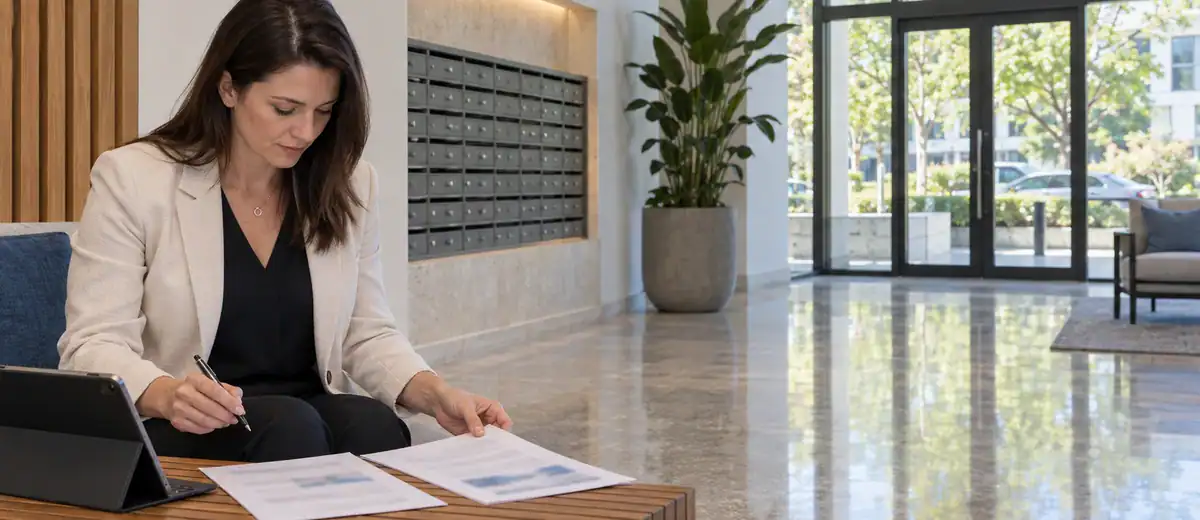
Appointing a strata cleaning company looks like a price decision and almost never is. The buildings that end up with recurring complaints, dirty bin rooms and an owners corporation asking awkward questions rarely chose a bad cleaner — they chose an undefined one. No written scope, no supervisor above the cleaner, no record of what was done. This guide covers what to actually check before you appoint, the questions that expose a thin proposal, and how to compare providers on something more useful than the bottom line.
It is written for the people who carry the consequence: strata and property managers, building managers and committee members. At Precimax Clean, an accredited commercial cleaning company in Perth trading since 2008, we clean common areas across the metro — so this is the view from the contractor side of the table, including the things a provider would rather you did not ask. It sits alongside our strata cleaning services in Perth, and complements the full strata cleaning guide and our strata cleaning checklist.
How do you choose a strata cleaning company?
Judge providers on capability and accountability, not hourly rate: a documented area-by-area scope, supervisor inspections recorded against it, screened and trained cleaners, current insurance and compliance evidence, specialist services in-house, and a defined reporting and escalation path.
Then compare like-for-like by giving every provider the same written scope and insisting on a site walk-through before any figure is quoted. A quote that is cheapest by a distance is almost always a thinner scope, not better value.
In this guide
What you’ll learn
- Why the appointment decision drives everything that follows
- The six things that separate a capable provider from a cheap one
- The questions to ask before you appoint — and the answers to expect
- Red flags that predict problems within the first quarter
- How to compare quotes like-for-like without guessing
- A five-step selection process you can defend to the committee
- How to switch providers without a gap in service
Why the appointment decision matters more than the price
Cleaning is one of the few building services residents experience every single day. They do not read the contract; they see the lobby floor, the lift buttons, the bin room in February. When cleaning slips, it does not stay a cleaning problem — it becomes a stream of complaints to the property manager, an agenda item at the next general meeting, and eventually a question about whether the manager is on top of the building.
The pattern is consistent. A building appoints on price, the scope was never written down properly, and within a quarter the low-visibility work quietly stops. Nobody notices the skirtings and the stairwell landings for a while. Then the bin room turns over summer, a resident photographs it, and the whole arrangement unravels — usually costing more to fix than the original saving.
Choosing well is not about paying the most. It is about appointing a provider whose work you can verify, so that when the committee asks whether the building is being cleaned properly you can answer with records rather than reassurance.
What to look for in a strata cleaning company
Six things separate a provider that will hold up over a two-year contract from one that will not. None of them are visible in a price.
1. A documented, area-by-area scope
The scope is the contract. It should name every common area — lobby, lifts, corridors, landings, stairwells, common toilets, bin room, car park, external entry — and state what happens in each and how often. “General clean of common areas, twice weekly” is not a scope; it is an invitation to interpret. If it is not written down, it is not enforceable, and the tasks nobody can see are the first to go.
2. Supervision above the cleaner
A cleaner attending unchecked will drift, however good they are. Ask whether there is a supervisor inspecting against the scope, how often, and what happens when an inspection fails. This is the single biggest difference between a service that holds its standard between visits and one that depends entirely on which cleaner turned up.
3. Screened and trained staff
Strata cleaners work unsupervised in residential buildings, frequently after hours, often with keys or fob access to secure areas. Police-cleared staff should be a baseline expectation, not a premium. Training matters too — chemical handling, colour-coded equipment, safe work procedures — because an untrained cleaner damages finishes, and stone lobby floors are expensive to put right.
4. Insurance and compliance you can see
Ask for the documents rather than the claim: current public liability, workers compensation, safe work method statements, safety data sheets for the chemicals used in your building, and any certifications held. Precimax Clean is an IICRC Certified Firm and ISO Compliant across 9001, 14001 and 45001 — and we expect to be asked for the evidence, not believed on it.
5. Specialist services in-house
Common areas need more than routine cleaning. Carpets need periodic extraction, hard floors need machine scrubbing, car parks and entries need pressure cleaning, and glass needs safe access. A provider delivering these in-house can coordinate them into one schedule; one that subcontracts everything adds a margin, a delay and a second party to chase. See our commercial carpet cleaning and facility management services for how that sits together.
6. Reporting you can hand to the committee
Documented cleaning is what converts “I think it is fine” into evidence. Area-by-area schedules, recorded inspections, photo reporting on issues and completed periodic work, and a defined escalation route for damage, hazards or repeat overflow. This is the part property managers value most once they have had it, and miss most when they do not.
Six checks before appointing a strata cleaner
Each one is answerable in a sentence by a provider that has it, and dodged by one that does not.
Documented scope
Every common area named, with tasks and frequency written down.
Supervision
A supervisor inspecting against the scope, not a cleaner attending unchecked.
Screened staff
Police-cleared and trained — they work unsupervised in a residential building.
Compliance evidence
Insurance, SWMS, SDS and certifications produced on request, not described.
Specialists in-house
Carpet, floor care, pressure cleaning and glass under one schedule.
Reporting
Records you can put in front of an owners corporation.
Six checks, one decision. A provider that can evidence all six is a provider you will not be re-tendering in twelve months.
Comparing providers for your building?
Free walk-through and a documented, area-by-area scope you can compare against.
Questions to ask before you appoint
These seven cut straight to whether a provider can actually deliver. A professional company answers all of them without hesitation, and usually volunteers the evidence.
- What quality systems do you use? — the documented scope, checklists, and how the standard is held between visits.
- How are cleaners supervised? — is a supervisor inspecting against the scope, and how often?
- Are inspections recorded, and can I see them? — records that exist but cannot be shown are not records.
- How are issues reported and escalated? — damage, hazards, repeat overflow: who is told, and how fast?
- What happens when staff are unavailable? — is there cover for leave and sickness, or does the building get skipped?
- What training and screening do your cleaners have? — police clearance, chemical handling, safe work procedures.
- What is specifically excluded? — the most revealing question of the seven, and the one most often left unasked.
Ask every provider the same seven and write down the answers. The differences will be obvious on the page in a way they never are in a meeting.
Red flags that predict problems
None of these guarantee a bad outcome on their own. Together, they are a reliable pattern — and they show up in the proposal long before they show up in the building.
What you are really comparing
Appointment signalsThe cheap appointment
Looks cheaper · costs more later
- Quotes a firm price without walking the building
- Scope is a paragraph, not a schedule
- No supervisor named above the cleaner
- Inspections described but never produced
- Insurance and compliance documents “can be sent later”
- No cover arrangement for leave or sickness
- Cheapest by a wide margin against every other quote
The documented provider
Priced from your actual building
- Walks the site before quoting anything
- Area-by-area scope with frequencies
- Named supervision and inspection cycle
- Sample inspection and cleaning records offered up front
- Insurance, SWMS and SDS provided with the proposal
- Documented cover so the building is never skipped
- Price sits within a sensible band and is explained
The single most useful red flag is the phone quote. A provider willing to price a building it has not seen is either guessing or planning to adjust later, and both end in the same conversation.
How to compare quotes like-for-like
Most quote comparisons fail because each provider scoped the building differently, so the numbers were never comparable. Fix that by issuing the same written scope to everyone, then compare against it line by line.
| What to compare | What a strong proposal shows |
|---|---|
| Areas included | Every common area named individually, including bin room, car park and external entry |
| Frequency per area | Different frequencies for different zones, matched to traffic — not one blanket figure |
| Periodic works | Carpet, hard floors, pressure cleaning and glass listed with an interval and whether they are included or additional |
| Consumables | Stated clearly as included or excluded, with who monitors stock |
| Supervision | Inspection frequency and what is recorded |
| Reporting | What the property manager receives, and how often |
| Cover | What happens when the regular cleaner is unavailable |
| Exit terms | Notice period and whether the contract locks you in |
Once those eight are filled in for each provider, the cheapest quote usually stops looking cheapest. If you want the underlying cost drivers in more detail, our guide to strata cleaning cost in Perth breaks down what actually moves a quote.
A five-step selection process
This is a process you can run in a fortnight and defend to a committee on more than price.
Appointing a strata cleaner in five steps
Structured enough to compare fairly, short enough to actually run.
Document the problem
What is failing now — complaints, missed areas, reporting gaps.
Write the scope
Area by area, with frequencies and the periodic works named.
Walk the building
Every shortlisted provider on site before anyone quotes.
Compare against the scope
Systems, screening, compliance and reporting alongside cost.
Appoint and set the baseline
Agree the first inspection date and what the first report will contain.
Scope first, price second. A common written scope is what turns four incomparable numbers into a decision you can justify.
Switching providers without a gap
Most managers delay a change because they expect disruption. In practice a handover is straightforward if three things are agreed before the last day of the outgoing contract.
- Keys, fobs and access — returned and reissued on a defined date, with after-hours access confirmed in advance.
- A reset clean — a deeper first service so the incoming provider starts from a known baseline rather than inheriting a backlog and being blamed for it.
- A documented first inspection — within the first fortnight, so the standard is recorded early and any gap is visible while it is still small.
Tell residents the provider is changing and when. Almost every complaint during a handover is about surprise rather than standard. For the detail of what the new provider should be doing each visit, hand them the strata cleaning checklist as the baseline scope — and for buildings where the bin room or car park is the recurring issue, the guides to bin room cleaning and car park cleaning set out what good looks like. If your portfolio includes residential complexes or mixed-use towers, see also apartment building cleaning and commercial common area cleaning.
Free walk-through
Compare us against your current provider
We walk the building, write an area-by-area scope, and quote from what is actually there. No lock-in contracts, and you keep the scope whether you appoint us or not.
What the cleaning contract should include
Once you have chosen a provider, the contract is what protects the building when circumstances change — a new building manager, a difficult summer, a dispute about what was agreed. Most strata cleaning agreements are far too thin, and the gaps only become visible at the point they matter.
The scope as an annexure, not a sentence
Attach the full area-by-area scope to the contract rather than describing it in a clause. It should be the same document you issued at tender, so there is no drift between what was quoted and what was signed. If a provider wants to substitute their own shorter version at contract stage, that is worth a conversation.
Frequency and hours stated explicitly
How many services per week, on which days, and within what window. After-hours access arrangements matter in residential buildings — residents notice cleaning at seven in the morning, and so do committees.
Periodic works and how they are triggered
Carpet extraction, machine scrubbing, pressure cleaning and high-level glass should each have an interval and a stated price basis, so they are budgeted rather than negotiated in a hurry when the lobby starts to look tired.
Reporting obligations
Name what the property manager receives and when: inspection records, photo reporting on issues, and notification of damage or hazards within a defined period. Reporting that is not written into the contract tends to fade after the first few months.
Cover, escalation and remedy
What happens when a cleaner is unavailable, who to contact when something is missed, and what the provider does to put it right. A remedy clause with a sensible timeframe is far more useful than a penalty nobody will ever enforce.
Notice period and no lock-in
A provider confident in its service does not need to trap a building. We work without lock-in contracts for exactly that reason: if the standard slips, the building should be free to move, and that keeps the pressure where it belongs.
Get those six into the agreement and most of the disputes that consume a property manager’s time simply do not arise. For the operational detail that sits underneath the contract, the strata cleaning checklist is the document to attach as the working standard.
Ask where a contractor actually works. A company already servicing buildings across Stirling and Hillarys can hold a tight schedule in the northern corridor. One quoting your building as its only job in the area is quietly pricing in a long drive, and that is usually the contract that starts slipping first.
Choosing a strata cleaner — common questions
What should I look for in a strata cleaning company?
Look past the hourly rate at capability and accountability: a documented scope that names every common area and frequency, supervisor inspections recorded against that scope, screened and trained cleaners, current insurance and compliance evidence, in-house specialist services, and a clear reporting and escalation path. A provider that can evidence all six is a provider you will not be re-tendering in twelve months.
How much should strata cleaning cost in Perth?
There is no standard price, because no two buildings are the same. Size, levels, lifts, resident numbers, which common areas are included, frequency and condition all move the number. Any provider quoting a firm price without walking the building is guessing. Our guide to strata cleaning cost in Perth explains what shapes a quote and what a proper proposal should contain.
What questions should I ask a strata cleaning company?
Ask what quality systems they use, how cleaners are supervised, whether inspections are recorded and can be shown to you, how issues are reported and escalated, what happens when staff are unavailable, what training and screening their cleaners have, and what is specifically excluded from the scope. A professional provider answers all seven without hesitation.
Are police checks required for strata cleaners?
There is no blanket legal requirement, but cleaners work unsupervised in residential buildings, often after hours and with access to keys, fobs and secure areas. Police-cleared staff should be treated as a baseline expectation in strata rather than a premium extra, and a provider should be able to confirm its screening process in writing.
How do I compare strata cleaning quotes fairly?
Give every provider the same written scope, then compare on what is included rather than the headline figure. A quote that is cheapest by a wide margin usually reflects fewer hours or a thinner scope, not better value. Check frequency per area, what periodic work is included, whether consumables are covered, and what happens when something is missed.
What are the warning signs of a poor strata cleaning provider?
A verbal or one-line scope, no written schedule, no supervisor above the cleaner, no inspection records, reluctance to provide insurance or compliance documents, no cover arrangement for leave and sickness, and a price notably below every other quote. Each one on its own is a question; together they are a pattern.
Should a strata cleaner provide reports?
Yes. Documented cleaning is what lets a property manager answer an owners corporation with evidence rather than assurance. Expect area-by-area schedules, recorded supervisor inspections, photo reporting on issues and completed periodic work, and a defined escalation path for damage, hazards and repeat problems.
Can one company handle cleaning, bin rooms and car parks?
It should. Splitting common areas across separate contractors is where accountability gets lost and periodic work slips. A provider running the whole building coordinates routine cleaning with bin room cleaning, car park cleaning and periodic works under one schedule — which is how our facility management service is structured.
Filed under: Strata & Property · All cleaning guides
Explore our services
One provider for the whole building
From common areas and bin rooms to periodic pressure washing and floor care — one IICRC-certified team, one tailored scope.
01
Strata cleaning
Common-area cleaning for Perth apartment buildings and complexes. Lobbies, lifts, corridors, bin rooms and car parks.
View service02
Commercial cleaning
Full commercial cleaning across Perth metro — offices, complexes and mixed-use buildings, daily to periodic.
View service03
Office cleaning
After-hours office cleaning for corporate, strata-managed and commercial tenancies across Perth.
View service04
Facility management
Coordinated building programs — pressure washing, windows, consumables and periodic works on one schedule.
View service05
Carpet cleaning
IICRC-certified commercial carpet steam cleaning for lobbies and corridors. Periodic and one-off.
View service06
Consumables supply
Hand soap, paper and sanitiser supplied and restocked, so shared amenities never run out.
View service